Mission-support electronics · regulated programmes · international B2B/B2G
Illustrative customer journey · Defence-industry supplier
From opportunity enthusiasm to controlled programme commitments.
Sentinel Systems Group shows how SaleQMS changes with the customer promise, transaction model and risk of the industry.
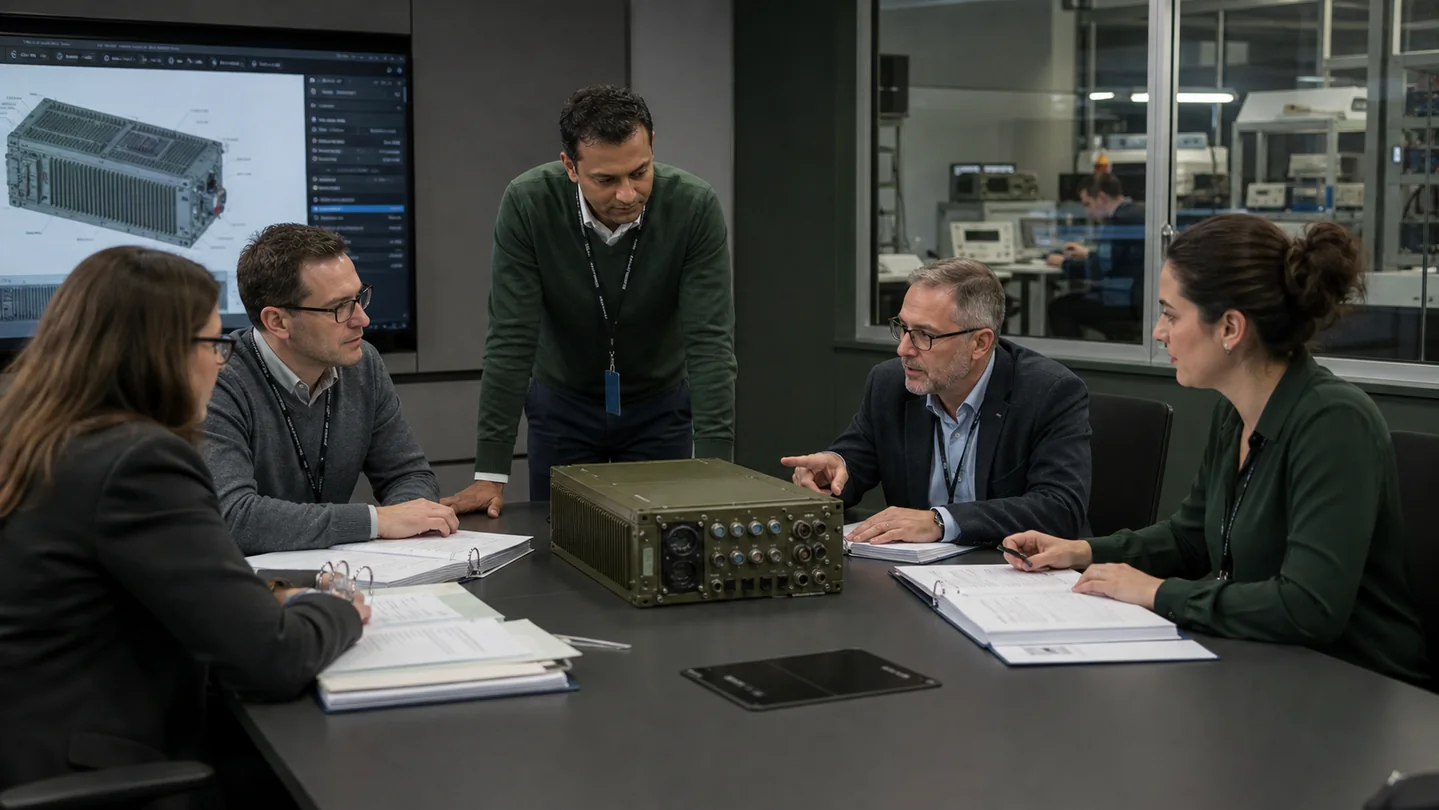
Composite example—not a customer testimonial.
Sentinel Systems Group is fictional. The workflow and figures are illustrative and must not be read as realised SaleQMS results, certification or a guarantee.
Commercial teams pursued complex tenders before export, security, configuration, capacity and customer-specific quality obligations were consistently understood.
Pre-contract decisions for non-classified support equipment and lifecycle-service programmes; no operationally sensitive information is used in this example.
Why change?
The commercial problem was also a customer-quality risk.
An unsupported capability, delivery or compliance statement could create programme delay, contractual exposure, security risk or loss of customer trust.
UNDERSTAND
Observed system
The team traced representative opportunities across customer contact, commercial decisions, operational interfaces and outcomes.
EVIDENCE
Evidence posture
Known facts, customer-confirmed requirements, internal inference, assumptions and missing information were kept visibly distinct.
The journey
Five steps from diagnosis to managed improvement.
The organisation tested a small, risk-relevant flow before extending the process.
01
DIAGNOSE
Trace actual customer journeys.
Sample recent wins, losses, changes and failures. Establish a baseline for customer experience, flow, rework, commercial outcome and risk.
02
DESIGN
Define the intended promise and ownership.
Agree the process purpose, scope, inputs, outputs, interfaces, decision authority and the conditions that require stronger review.
03
CONTROL
Introduce minimum useful controls.
- Opportunity screening for jurisdiction, end use, export, security and ethical escalation
- Requirements baseline separating customer source, applicable obligation, interpretation and open question
- Cross-functional feasibility review covering configuration, suppliers, competence, capacity and lifecycle support
- Authorised commitment register with controlled assumptions, exceptions and changes
04
PILOT
Use real work and remove friction.
The organisation piloted the flow on a non-classified support-system tender. Commercial, programme, engineering, quality, security and trade-compliance roles agreed decision gates and evidence ownership before proposal release.
05
VERIFY & IMPROVE
Compare outcomes, causes and unintended effects.
Management reviewed whether the change improved customer and business outcomes. Corrective actions addressed systemic causes; completed activity alone was not accepted as proof of effectiveness.
Illustrative outcome
Measures that fit this sales system.
Replace every figure with a controlled organisational baseline and verified result.
These figures are narrative examples. They do not establish causation or predict an applying organisation’s results.
Quality-system connection
SaleQMS made commercial control part of normal management.
The case connects especially with ISO 9001 themes concerning organisational context, interested parties, risk-based planning, requirements review, design and configuration interfaces, external providers, traceability and controlled change; sector-specific obligations may also apply. Exact applicability must be determined from the organisation’s context and authorised standard.