Motor and drive systems · project and replacement sales
Illustrative customer journey · Industrial motor sales
From product selection to assured operating performance.
TorqueNorth Drives shows how SaleQMS changes with the customer promise, transaction model and risk of the industry.
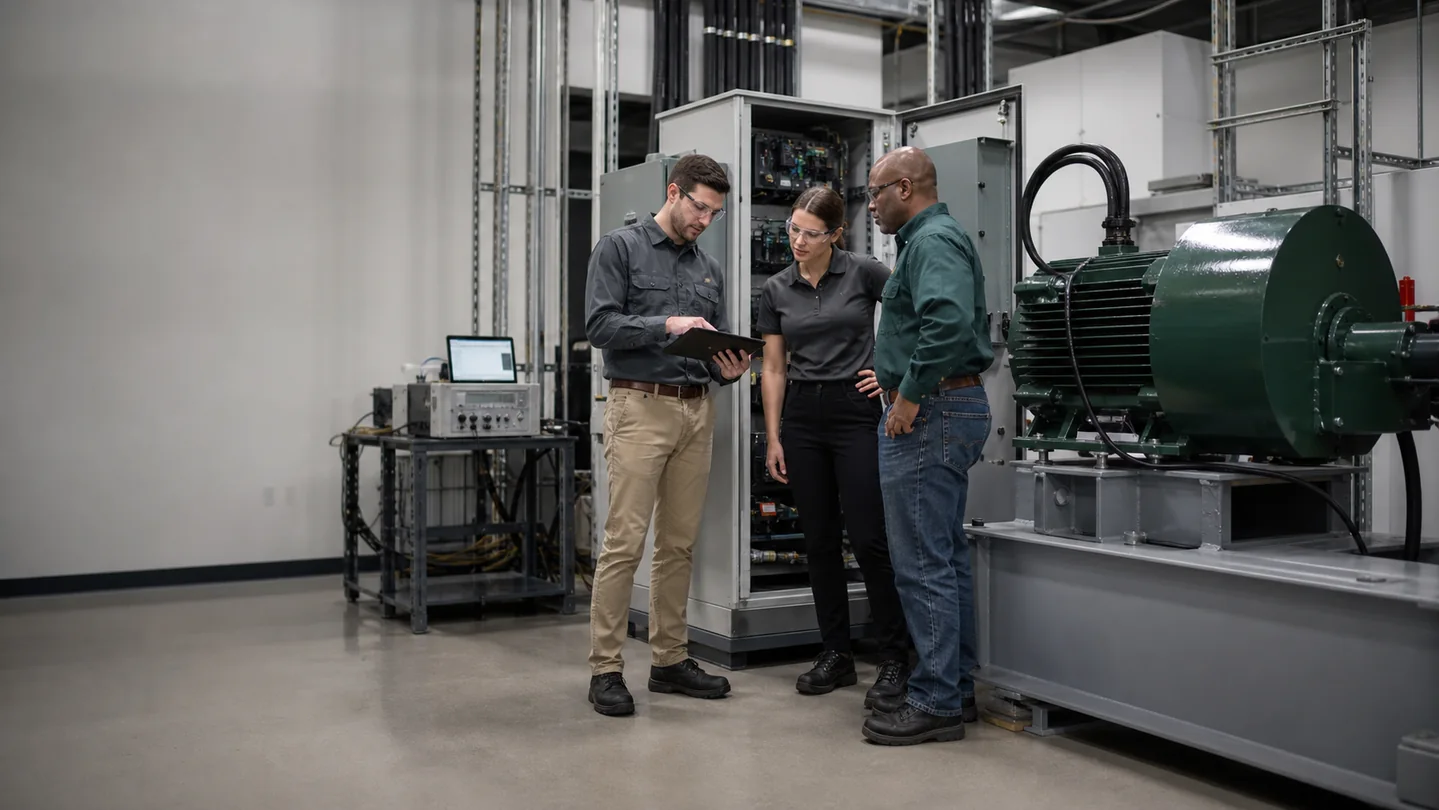
Composite example—not a customer testimonial.
TorqueNorth Drives is fictional. The workflow and figures are illustrative and must not be read as realised SaleQMS results, certification or a guarantee.
Motor selection relied heavily on experienced sellers and incomplete customer duty-cycle information.
Configured motors and drive packages for critical or non-standard operating environments.
Why change?
The commercial problem was also a customer-quality risk.
An incorrect motor, enclosure, control method or efficiency assumption could cause downtime, energy loss, unsafe operation or warranty disputes.
UNDERSTAND
Observed system
The team traced representative opportunities across customer contact, commercial decisions, operational interfaces and outcomes.
EVIDENCE
Evidence posture
Known facts, customer-confirmed requirements, internal inference, assumptions and missing information were kept visibly distinct.
The journey
Five steps from diagnosis to managed improvement.
The organisation tested a small, risk-relevant flow before extending the process.
01
DIAGNOSE
Trace actual customer journeys.
Sample recent wins, losses, changes and failures. Establish a baseline for customer experience, flow, rework, commercial outcome and risk.
02
DESIGN
Define the intended promise and ownership.
Agree the process purpose, scope, inputs, outputs, interfaces, decision authority and the conditions that require stronger review.
03
CONTROL
Introduce minimum useful controls.
- Application data sheet covering load, duty, environment, supply, control and acceptance
- Engineering verification proportional to novelty and operational consequence
- Controlled deviation record for incomplete or customer-directed selections
- Serialised configuration baseline transferred to order, commissioning and service
04
PILOT
Use real work and remove friction.
The team started with replacement motors for process-industry customers. It reviewed recent failures, defined minimum application evidence and piloted an engineering gate only where risk justified it.
05
VERIFY & IMPROVE
Compare outcomes, causes and unintended effects.
Management reviewed whether the change improved customer and business outcomes. Corrective actions addressed systemic causes; completed activity alone was not accepted as proof of effectiveness.
Illustrative outcome
Measures that fit this sales system.
Replace every figure with a controlled organisational baseline and verified result.
These figures are narrative examples. They do not establish causation or predict an applying organisation’s results.
Quality-system connection
SaleQMS made commercial control part of normal management.
The case connects especially with ISO 9001 themes concerning operational planning, product and service requirements, design controls where applicable, identification and traceability, release, nonconforming outputs and improvement. Exact applicability must be determined from the organisation’s context and authorised standard.